Examples of Patterns
Heroes...
In surface pattern work, it is common to design in collections consisting of hero patterns, coordinate patterns and blender patterns.
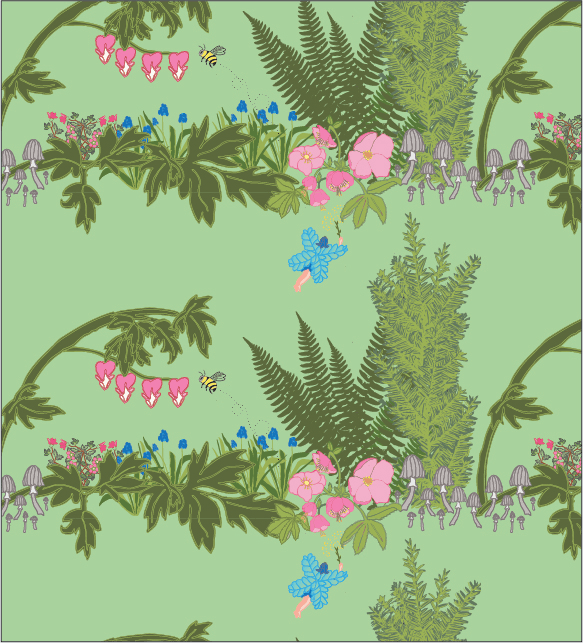
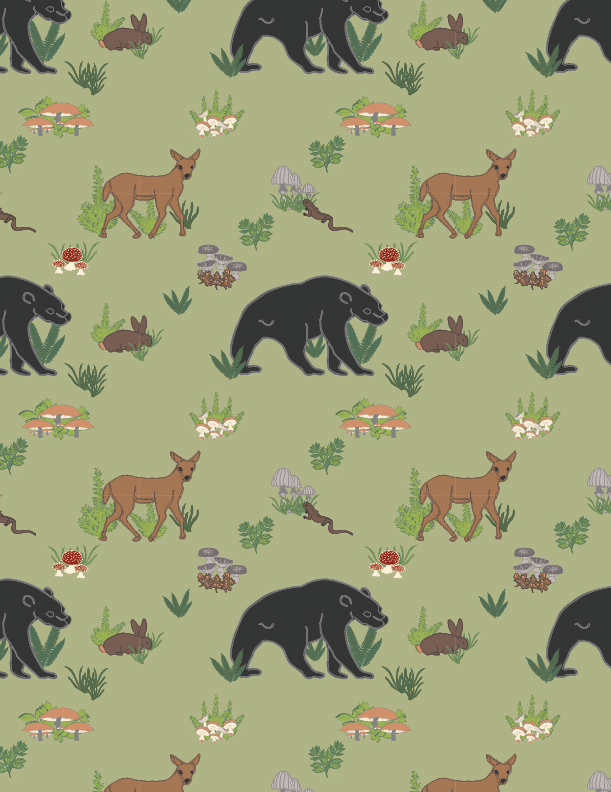
Here are examples of heroes patterns from two of my collections.
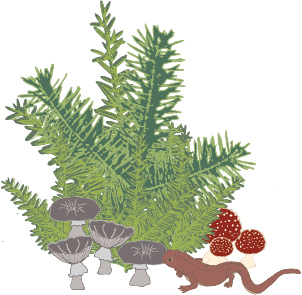
The top picture is from my Verging on Spring collection, and the pattern is called Fungi Forest, in the Evening color way. In the PNW, we tend to have way more than the usual four seasons! "Verging on spring" represents a period when winter is waning, but true spring has not arrived. It is a very wet time here, which leads to an explosion of fungi.
The bear was drawn from a hastily snapped photo of a black bear that casually walked in front of our house in mid-afternoon. All the flora, fauna and fungi in this pattern are found on our peninsula, and the newt was the first ground animal to greet us when we arrived here. (Fun note: we originally believed the neighbors were yanking our chains regarding the bears. We later came to find out that the largest concentration of black bears in Pacific County WA is actually on the Long Beach peninsula, where we live.)
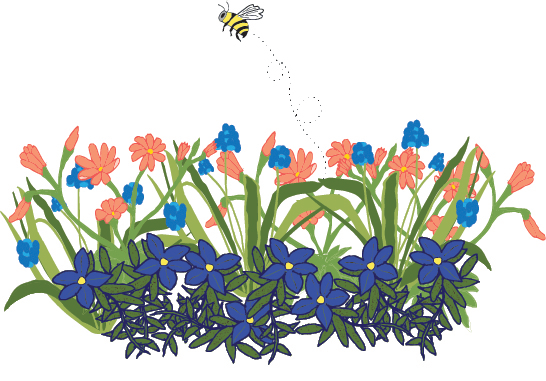
The second pattern is a hero from the Fantasy Forest collection. This collection, like our property, represents the area where gardens merge into the wilder areas. Such places are quite magical, and it is not unusual to feel the presence of those who inhabit such liminal spaces.
Coordinates...
Coordinate patterns support the heroes. They provide similar themes and colors, yet in a less bold way. This is useful for projects that might include or need several patterns in the same "family."
The pattern on the top is a coordinate pattern in the Verging on Spring collection, this time in the Afternoon color way. It is a diagonal print featuring the animals, foliage and fungi found in the heroes for that collection.
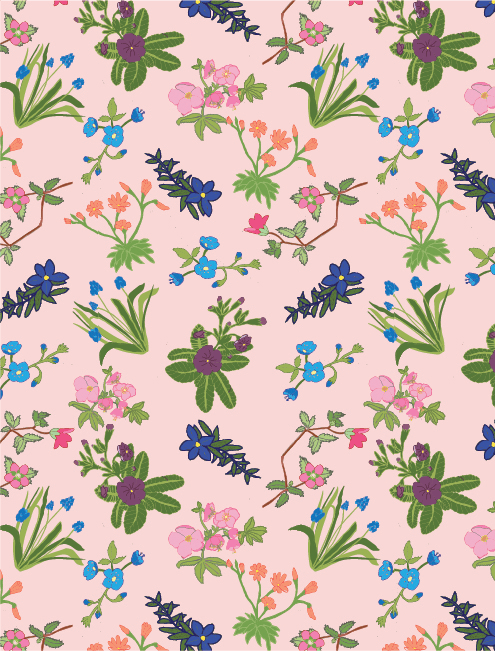
The bottom pattern is a "toss" pattern featuring the many flower motifs used in the hero prints for the Fantasy Forest collection. As a gardener, it has been so fun to learn about the species that grow so well here in our very moist environment, so different from the arid conditions we had before. Here you see primroses (which I was growing before, but which thrive here instead of merely barely surviving), lewisia, grape hyacinth, helebore, lomatium, wild raspberry, and lithadora, a surprising flower that is very intensely blue.
Blenders...
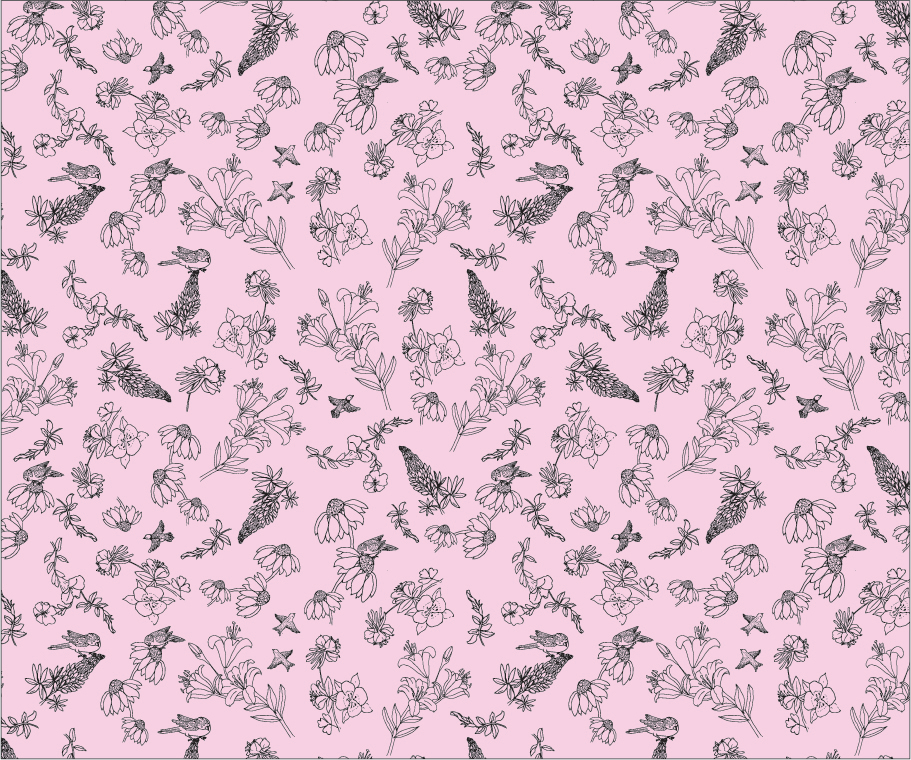
Here are two examples of blender patterns. These are both comprised of only two colors. The top image features the inked black sketches of birds and flowers I used across several patterns in the Portals collection, where they show up colored versions in the hero or coordinate patterns. This pattern could also be easily changed to another two-color color way.
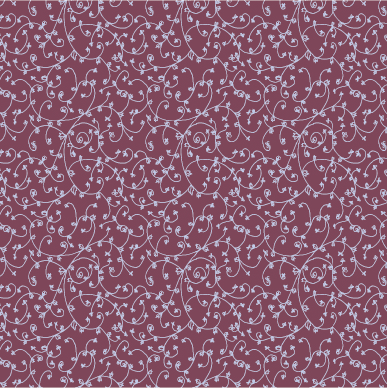
The bottom pattern is a hand-drawn trailing pattern, with the repeat also done by hand. It also has only two colors and is featured as a blender in the Verging on Spring collection, in green. It is an impressionistic representation of the thick blackberry vines we have here, everywhere, including on our property, where they tend to entangle my feet!
Scale
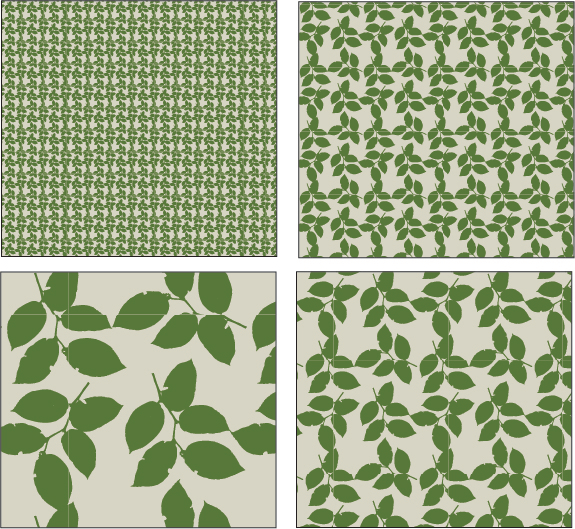
Here is an example of how vectorized patterns can be scaled to match the use.
Sadly, the exported translation of vectorized images to the website often renders the designs with flaws that are not there in the original version at any scale, such as hairlines or pixelation (there is NO pixelation in vectorized images for example). Since I am not a web designer I do not have an easy fix for this issue. You can see the hairlines here, and the pixelations show up in the 'banner' uses to define sections of the site. Not so fun note: when I first saw the hairlines as I was populating this site with the patterns, I just about choked!! I went back into each pattern and expanded the scale and moved the patterns all around looking for them, but they are not there in the vectorized versions. Perhaps my web guy can do something about it.
These images are here to demonstrate the way one pattern can look dramatically different in different sizes. This is also a blender pattern.
This pattern, Salal, is based on the leaves of the salad plant, ubiquitous to the PNW. These leaves are often used by florists in arrangements, as they are long lasting when cut.
Stand alone prints...
Stand alone prints used the same motifs as repeating patterns, but they are not intended to repeat.
Here, I have used one motif of the primrose with some type and created a frame around it for a greeting card. There is also a blurb about the meaning of this flower. If you look closely at the 'frame' around the central image, you will see it is 'textured' by the application of a cedar leaf pattern in grey. This is only one example of ways in which motifs can be used in a stand alone way.
Below the greeting card, you will see a 'logo' for my Fungi Forest collection.
Next to those examples I have included some examples of 'playing around' with motifs. The planting bowl also has an overlay of a basket weave pattern.
Often, repeating patterns can be used with stand alone prints in many applications.